
Why AI Won't Destroy Enterprise SaaS
I think the stocks are taking a bigger beating than they deserve.

What is Enterprise SaaS?
Enterprise SaaS is just the umbrella term for the business software that companies rent on a per-user basis. Your CRMs, your ERPs, your HCMs. Salesforce, HubSpot, Workday, ServiceNow all fall in this bucket.
So what actually are these tools?
Having worked at HubSpot and running RISE, I think I have a decent idea of what a tools actually are.
A CRM is a glorified address book that learned how to send emails. You store contacts, track conversations, send follow-ups. Over time, tools like HubSpot bolted on lead scoring, automation, pipeline management and now it runs most of the sales/ revenue department for many companies. But at its core it’s still a system of record for your customers.
An ERP is the same idea, but for everything else. Employees, your payroll, your invoices, your supply chain. Workday handles the HR and workforce side. SAP and Oracle handle operations and finance. ServiceNow manages IT workflows.
HubSpot (HUBS) — down 70% from its early 2025 highs.
Salesforce (CRM) — down 40% from its 2025 highs.
Workday (WDAY) — down 40% from its 2024 all-time high.
Monday.com (MNDY) — down 44% over the past year.
Why is the market doing this?
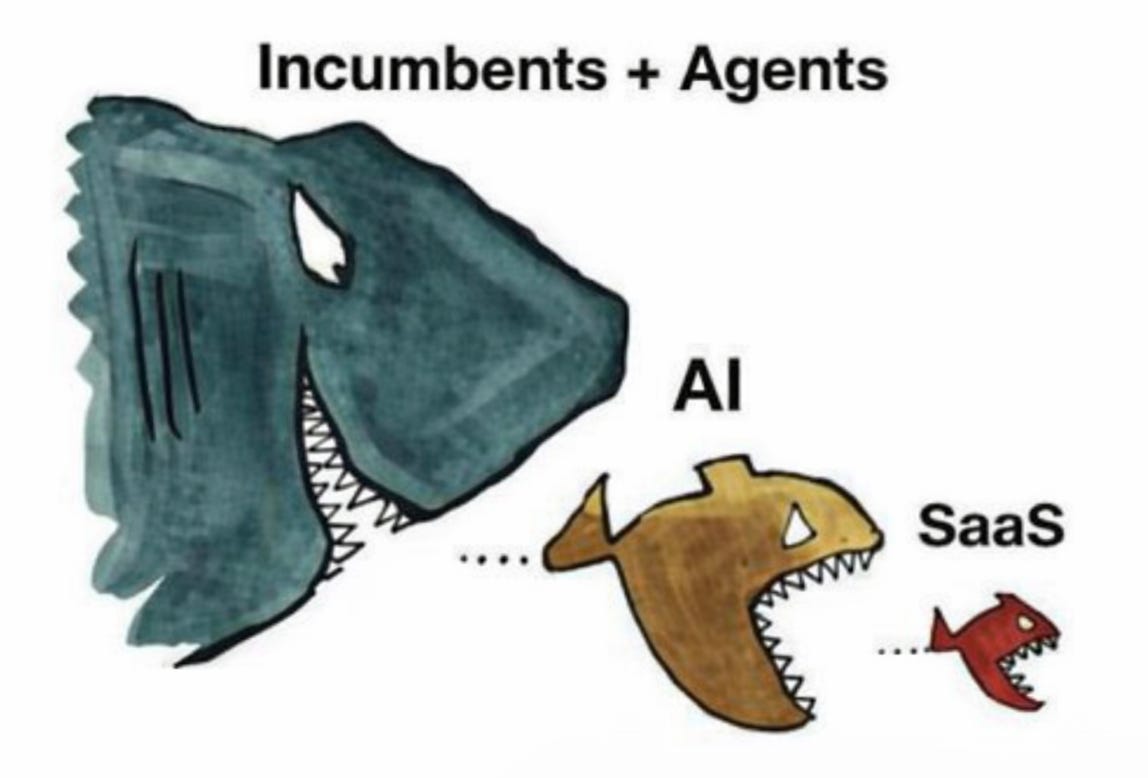
Enterprise SaaS is getting crushed as investors fear AI will commoditize the workflows these companies charge premium per-seat prices for. The thought is why will companies pay for CRM, HR, or project management tools when AI agents can automate much of that work at a fraction of the cost? I disagree.
Why I think enterprise software is here to stay
1. Anthropic isn’t coming for your CRM.
Every AI tool that scores leads, automates outreach, or routes tickets needs structured data. That data lives in the CRM. The outputs get logged back in the CRM. AI is a layer on top of these platforms, not a replacement for them.
And Anthropic, OpenAI, Google are not coming to build a CRM. The opportunity isn’t big enough and it’s not their business. They’ll let people build agents on their models, but they’re not going to sell seat licenses to manage your sales pipeline. They’re infrastructure companies focussing on a bigger one winner takes all market, not application companies. This is a bad distraction.
Meanwhile, the enterprise platforms control the access. They own the APIs. They decide which external agents can read and write to their systems, what data gets exposed, and what gets blocked. They can enforce OAuth scopes, rate-limit third-party agent calls, restrict API access to certified partners, or just build their own agents and bundle them into existing contracts. Salesforce is already doing this with Agentforce. If an outside AI agent wants to touch your Salesforce data, it still has to go through Salesforce’s front door.
2. Compliance isn’t optional
HubSpot and Workday carry SOC 2 Type II, ISO 27001, GDPR frameworks, Sarbanes-Oxley obligations. At HubSpot, there was a team of around 100 software engineers whose job was managing internal compliance tooling integrated with Workday Learning just to keep the company compliant.
No enterprise handling millions of customer records is replacing Salesforce with something a developer vibe-coded over a weekend. These companies operate under GDPR, CCPA, SEC, FINRA, PCI-DSS. Meta got fined €1.2 billion under GDPR in 2023. Building in house is a high effort + risk, low reward activity. It would be foolish to do.
3. Insurance and liability
When companies sign enterprise SaaS contracts, those contracts come with indemnification clauses. The vendor agrees to cover losses from data breaches and outages. They carry cyber liability insurance, E&O insurance (Errors & Omissions/ "we messed up" insurance), fidelity bonds (SaaS platform employee stealing data).
An in-house AI tool doesn’t come with any of that. It’s a pain to manage and very risky.
4. Software was never the moat
HubSpot and Salesforce didn’t become multibillion companies because its CRM was technically better. They won because of integrations on Platforms like AppExchange and thousands of consulting partners, events like INBOUND and decades of brand trust. The moat was always distribution and brand trust, not code.
A better AI model doesn’t replace any of that. Also, these companies aren’t sitting still. In the last few months alone, HubSpot acquired XFunnel to help businesses show up in AI-generated answers, and Starter Story to expand their YouTube network to 2.9 million subscribers. They’re adapting fast.
5. Switching cost is brutal
The average enterprise CRM implementation is 6–12 months, hundreds of thousands in consulting, migration, training, integrations and years of baked in data.
What do I think is the future of Enterprise SaaS?
IMO the pricing model will change. I don’t agree with the post here entirely but I think there are some good points.


If AI agents do the work such as entering records, companies need fewer seats, and the current revenue model breaks. Fewer humans logging in doesn’t mean less work getting done. It means fewer seats but higher value per seat due to new agent-based pricing lines, and the same platforms running underneath all of it. The software doesn’t go anywhere since agents still need a system to read from and write to but fewer seats will be required.
Enterprise software spending is growing 15% this year to $1.43 trillion. The idea of seats isn’t going anywhere, companies will just have to figure out a way to charge on the basis of agent usage. Revenue will probably increase as a result. And these platforms control the API access. If they want to block external agents and force customers onto their own agents, they can. That's even greater lock-in, not less.
My bet is these stocks are undervalued. The market is pricing in death/ companies not being able to adapt. Enterprise SaaS is much trickier than it seems at scale + vendor lock in is real. My guess is these companies will acquire and build their way into the AI agent layer over the next year. Revenues won’t decrease. Companies will happily pay more per seat if it means needing fewer employees.
Unless one of these companies seriously falls behind in the AI application game I don’t see any disruption in their market share. They will continue to do well.
More promising details:
I think a major reason for the stock collapse is also that, capital has rotated out of software and into AI infrastructure plays.
Salesforce: Agentforce ARR went from $100M in Q1 FY26 to $540M in Q3 to $800M in Q4, with 29,000 total deals closed. Full year FY26 revenue hit $41.5B. They’re not getting disrupted by AI agents but are selling them.
HubSpot: Full year 2025 revenue hit $3.1B, growing 18% YoY. Guiding $3.7B for 2026. Over 8,000 customers activated their Customer Agent and 10,000 on their Prospecting Agent. 288,000 total customers. They’ve introduced a credits-based consumption model for agent usage on top of seat pricing.
Monday.com: Revenue grew 26% YoY to $1.23B in 2025. Enterprise customers (over $100K ARR) grew 48% YoY. Launched monday agents, monday magic, and monday campaigns, with 46 million AI-driven actions executed on the platform. 250,000+ customers.
Workday: FY26 subscription revenue hit $8.83B, up 14.5% YoY. AI product revenue now exceeds $400M annualized. Over 75% of new deals include at least one AI product. They acquired Paradox (AI recruiting), Sana (AI learning), and Pipedream (AI agent integrations). 11,000+ customers including 65% of the Fortune 500.